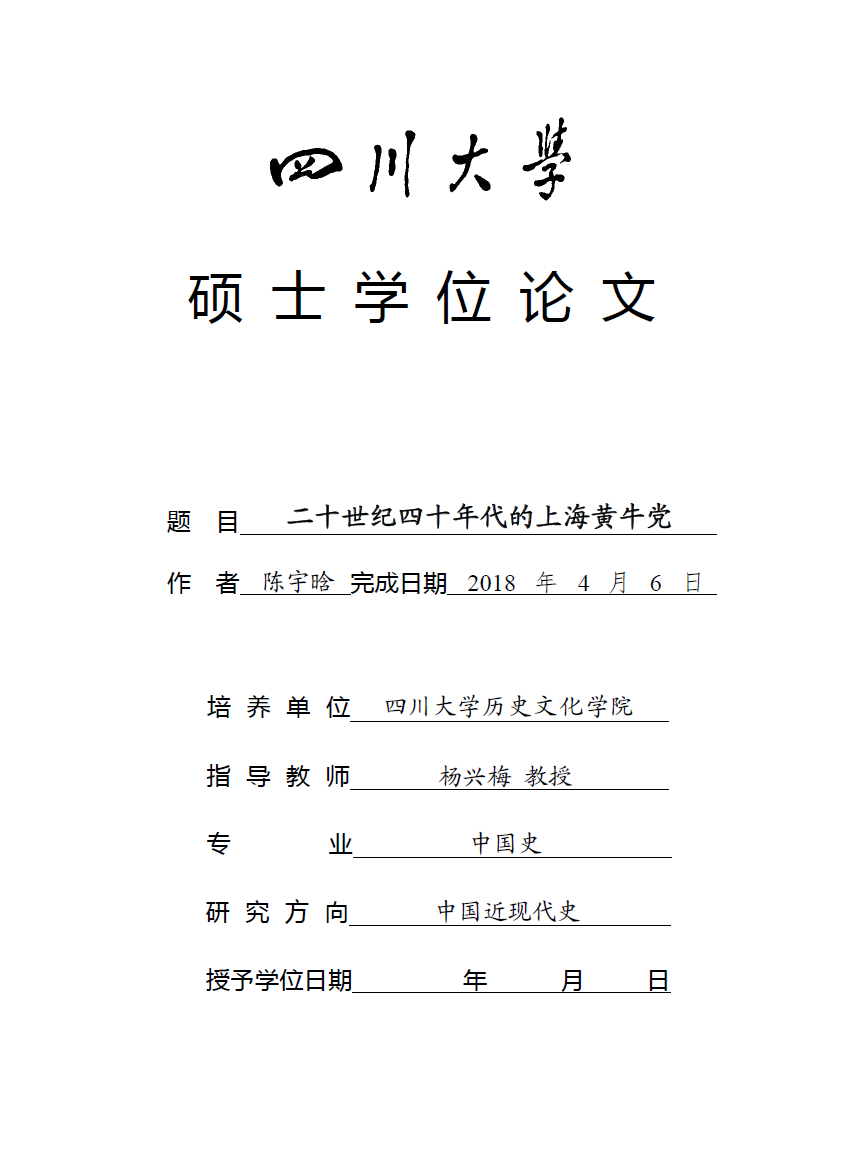
Shanghai Scalpers in 1940s
Submitted to Sichuan University 四川大學, 2018
Abstract: The Shanghai scalper was a huge group in 1940s. It had a great impact on Shanghai’s economic and people’s daily life. Before the formation of the word “huangniu dang”, the “feipiao”, commonly used in the northern areas, was used to describe black market ticket. The “huangniu dang” has the local urban cultural color of Shanghai, it was made up of “huangniu” (yellow ox) and “dang” (gang).
The power of scalper came into being during the War of Resistance Against Japan. It initially started scalping the parity rice. Due to the severe shortage of railway capacity in the wartime and early postwar period, the scalper was active in Shanghai to rush for train tickets. During the war, the Central China Rail Corp (華中鐵道公司) and the Nanjing Shanghai Railway Administration (京滬鐵路管理局) were reformed in the system of purchasing and riding. But in the face of market demand, the scalper was willing to take the risk. Chiang Ching-kuo's “8-19 price limit” provided a wide range of space for scalpers. They had spared no effort to buy goods on the shelves of the stores. The trade associations united merchants as much as possible in order to minimize the loss, but it was also powerless for the collapse of the economy. The opening of gold and silver exchange had led to a stampede against gold. The scalper had become one of the few winners in the whole currency reform. Under the new regime, they had been identified as a exploiter and classified into the category of vagrant transformation. However, in the early days of the founding of new China, quite a number of scalpers were active in the streets of Shanghai, engaged in scalping activities, and succeeded in the new regime.
The Xincheng Bureau has a large number of scalpers in the territory of the theater. In order to avoid the risk and maximize the maximum benefit, scalpers formed a number of small groups, with a clear division of labor and cooperation, to create a complete chain of black market ticket trading. In scalpers’ social network, there also had police, theater and audience. The four forces were connected and interact together to form a relatively stable structure.
The scalper is the product of contradiction between supply and demand, and has its rationality of existence. Institutional change is necessary for banning the scalper, but it cannot solve the problem completely. On the basis of economic development, the contradiction between supply and demand is fundamentally alleviated, and the problem is solved naturally.
The power of scalper came into being during the War of Resistance Against Japan. It initially started scalping the parity rice. Due to the severe shortage of railway capacity in the wartime and early postwar period, the scalper was active in Shanghai to rush for train tickets. During the war, the Central China Rail Corp (華中鐵道公司) and the Nanjing Shanghai Railway Administration (京滬鐵路管理局) were reformed in the system of purchasing and riding. But in the face of market demand, the scalper was willing to take the risk. Chiang Ching-kuo's “8-19 price limit” provided a wide range of space for scalpers. They had spared no effort to buy goods on the shelves of the stores. The trade associations united merchants as much as possible in order to minimize the loss, but it was also powerless for the collapse of the economy. The opening of gold and silver exchange had led to a stampede against gold. The scalper had become one of the few winners in the whole currency reform. Under the new regime, they had been identified as a exploiter and classified into the category of vagrant transformation. However, in the early days of the founding of new China, quite a number of scalpers were active in the streets of Shanghai, engaged in scalping activities, and succeeded in the new regime.
The Xincheng Bureau has a large number of scalpers in the territory of the theater. In order to avoid the risk and maximize the maximum benefit, scalpers formed a number of small groups, with a clear division of labor and cooperation, to create a complete chain of black market ticket trading. In scalpers’ social network, there also had police, theater and audience. The four forces were connected and interact together to form a relatively stable structure.
The scalper is the product of contradiction between supply and demand, and has its rationality of existence. Institutional change is necessary for banning the scalper, but it cannot solve the problem completely. On the basis of economic development, the contradiction between supply and demand is fundamentally alleviated, and the problem is solved naturally.
Language: Simplified Chinese
Words: 90,000